


How does a reverse mortgage work?
Understanding how does a reverse mortgage work starts with one basic idea: it lets an eligible homeowner convert part of their home equity into available funds without a required monthly mortgage payment.
The most common type is the Home Equity Conversion Mortgage, or HECM. According to Green Monarch's source material, a HECM is federally insured and available to homeowners age 62 and older.
You keep title to your home.
You continue living in your home.
And instead of making a required monthly principal and interest mortgage payment, the loan is generally repaid when you sell the home, permanently move out, or pass away.
That sounds simple, but there is more you should understand before deciding whether a reverse mortgage makes sense for you.

Reverse mortgage how does it work?
For homeowners asking how does a reverse mortgage work in California, the basic HECM works similarly to one elsewhere in the country, but California adds important borrower protections.
California's housing market also matters.
Home values in many areas of California can be considerably higher than in other parts of the country, which can affect how homeowners think about available equity and the federal HECM lending limit.
So there are really two things to understand:
How the reverse mortgage itself works, and what is different when you get one in California.
Reverse mortgage how does it work?
When someone asks the question, reverse mortgage how does it work, it helps to break the process into a few basic pieces.
You have equity in your home.
A reverse mortgage allows an eligible homeowner to convert a portion of that equity into available loan proceeds.
The amount you may qualify for is not simply the total amount of equity you have.
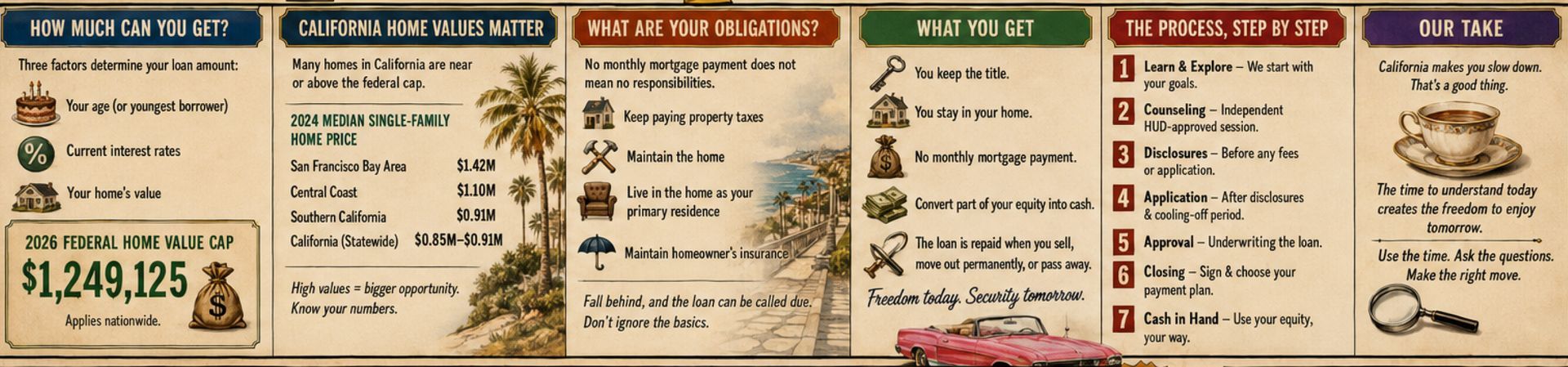
According to Green Monarch's source material, important factors include your age, or the age of the youngest borrower, current interest rates and your home's value. The federal HECM program also limits the amount of home value that can be used in the calculation.
Once the loan is established, you continue owning and living in the home as long as the applicable loan requirements are met.
Reverse mortgage what is it how does it work?
For homeowners searching reverse mortgage what is it how does it work, a reverse mortgage is still a mortgage loan.
That distinction matters.
It is not free money.
It is not a government benefit.
And the lender does not take ownership of your house simply because you have a reverse mortgage.
With a HECM, you remain the homeowner and keep title to the property. You are borrowing against a portion of the equity you have built in the home.
The loan balance changes over time, and the loan eventually must be repaid.
Understanding that upfront makes everything else about a reverse mortgage easier to understand.
Do I Still Own My Home With a Reverse Mortgage?
The answer to do I still own my home with a reverse mortgage is yes.
You keep the title to your home.
That is one of the most misunderstood aspects of reverse mortgages.
The lender does not simply become the owner of your house. You continue to own and live in the property while meeting the terms and requirements of the loan.
That also means you retain important responsibilities as the homeowner.
Those responsibilities don't disappear just because your mortgage works differently.
Do I Make Monthly Mortgage Payments?
With a HECM, required monthly principal and interest mortgage payments are generally not made by the borrower.
That's one of the defining differences between a traditional mortgage and a reverse mortgage.
With a traditional mortgage, you borrow money and then make monthly principal and interest payments to reduce what you owe.
With a reverse mortgage, you can access a portion of your home equity without making required monthly principal and interest mortgage payments.
But that does not mean you have no housing expenses or financial responsibilities.
Property taxes, homeowners insurance and other applicable property obligations remain your responsibility.
What Do I Still Have to Pay With a Reverse Mortgage?
Homeowners need to understand
what you still have to pay with a reverse mortgage before focusing on the benefit of eliminating a required monthly principal and interest mortgage payment.
According to Green Monarch's source material, homeowners must continue to:
- Pay their property taxes
- Maintain homeowners insurance
- Keep the home in reasonable repair
- Use the home as their primary residence
Failing to meet applicable obligations can cause the loan to become due.
This is one of the most important parts of understanding how a reverse mortgage works.
No required monthly principal and interest mortgage payment does not mean no homeowner expenses.
How Much Money Can I Get From a Reverse Mortgage?
The amount
how much money can I get from a reverse mortgage represents for you depends on several factors rather than one standard percentage.
Green Monarch's source identifies three primary variables:
- Your age, or the age of the youngest borrower
- Current interest rates
- Your home's value
Failing to meet applicable obligations can cause the loan to become due.
This is one of the most important parts of understanding how a reverse mortgage works.
The HECM program also limits the home value used in calculating the available loan amount.
For 2026, Green Monarch's source states that the maximum claim amount for Home Equity Conversion Mortgages is $1,249,125 for applicable case numbers assigned on or after January 1, 2026.
That can be particularly important in California because many homes have values approaching or exceeding the federal limit.

Why California Home Values Matter
For homeowners throughout the state, California home values can affect reverse mortgage calculations in ways worth understanding.
The source article points out that California's median home values are high enough that homeowners in some regions may own properties near or above the federal HECM limit.
The table included on page 4 of Green Monarch's source illustrates the issue. It reports an April 2025 statewide single-family median sold price of $910,160, a Southern California figure of $887,000, a Central Coast figure of $1.09 million and a San Francisco Bay Area figure of $1.419 million.
That does not mean a homeowner can borrow the entire value of the property.
It means the HECM calculation needs to account for both the home's value and the federal program limit.
What Are My Ongoing Obligations?
A reverse mortgage removes your monthly mortgage payment.
It does not remove your responsibilities as a homeowner.
In California, as everywhere, you must:
- Keep paying your property taxes.
- Keep the home in reasonable repair.
- Live in the home as your primary residence.
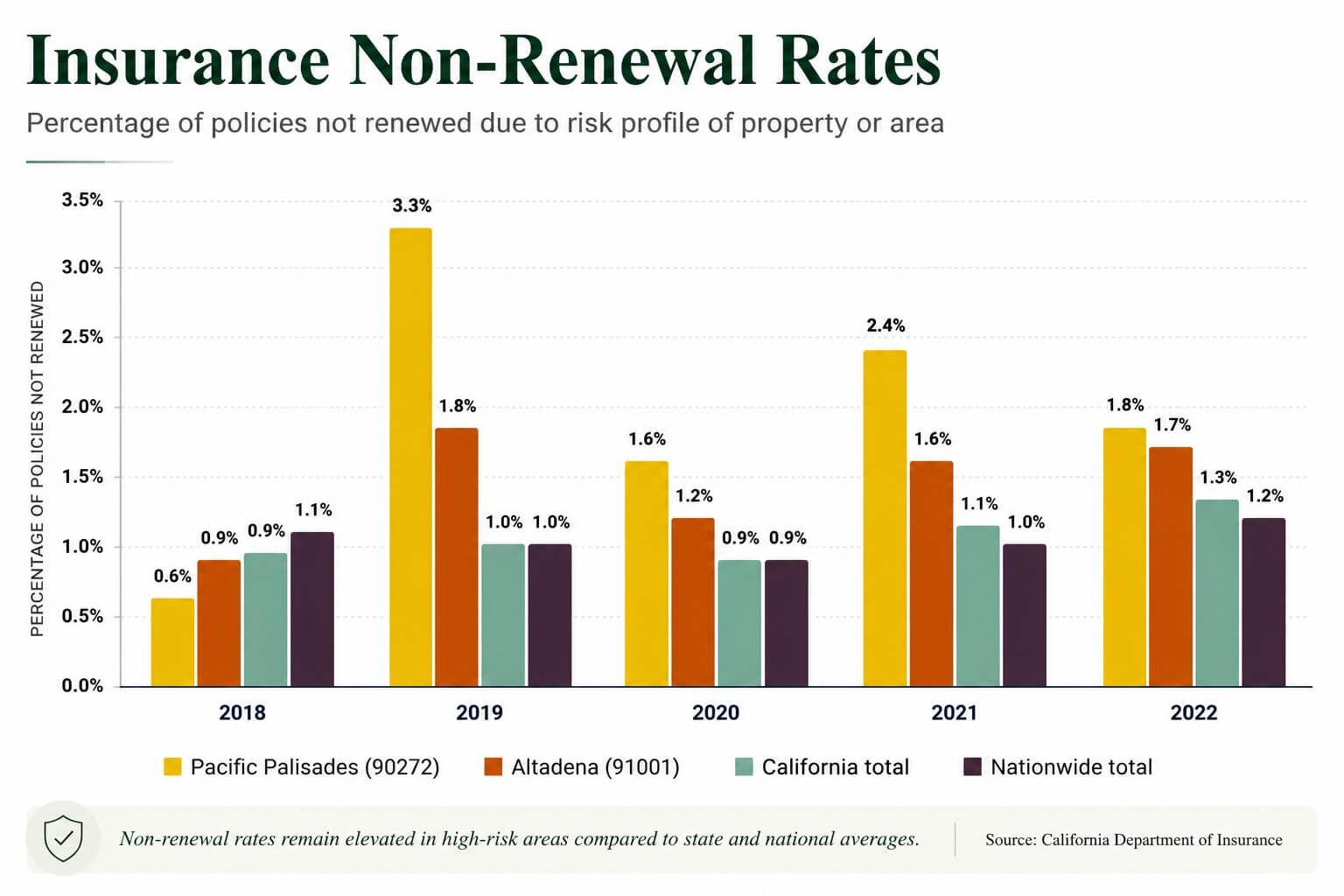
- Maintain homeowner’s insurance, worth flagging given California’s welldocumented insurance market challenges in fire-prone areas, where premiums have risen, and coverage has become harder to find.
Percentage of policies not renewed due to risk profile of property or area.
Fall behind on these and the loan can be called due.
This is the single most common way reverse mortgages go wrong, so we’d rather over-emphasize it than have you learn it later.
What Extra Reverse Mortgage Protections Does California Have?
California provides additional reverse mortgage borrower protections on top of the federal HECM requirements discussed in Green Monarch's source material.
One of the most significant is a mandatory waiting period.
The source states that counseling must be completed at least seven days before a lender can assess fees or accept a final and complete application.
In practical terms, California homeowners are given time between counseling and moving forward with the application.
Green Monarch views that waiting period as a benefit, not an inconvenience.
As the original article puts it:
A loan that doesn't survive seven days of thinking it over is a loan you shouldn't take.
What Reverse Mortgage Disclosures Do California Borrowers Receive?
Before moving forward, California reverse mortgage disclosures provide another opportunity to understand what you're considering.
Green Monarch's source says California borrowers must receive a Reverse Mortgage Worksheet Guide and an Important Notice to Reverse Mortgage Loan Applicant before counseling and before the initial loan application.
The purpose is to put important questions in front of the homeowner before fees are charged and before the process gets too far along.
Use those disclosures.
Read them.
Write down questions.
A reverse mortgage should make more sense as you move through the process, not less.
Do I Have to Get Reverse Mortgage Counseling?
For a HECM, independent HUD-approved reverse mortgage counseling is part of the process.
Green Monarch's source explains that a California homeowner cannot obtain a HECM without first meeting with a counselor who does not work for the lender.
The counselor's role is to help make sure you understand the costs, obligations and alternatives associated with the loan.
This is an important safeguard.
The person helping you understand the basic loan requirements is separate from the lender offering you the mortgage.
Can I Change My Mind About a Reverse Mortgage?
Borrowers also have a right to cancel after signing in circumstances covered by the rescission rules discussed in Green Monarch's source.
The article states that federal law provides a three-day period after signing the final loan documents during which the borrower can cancel the loan.
Combined with California's disclosures, counseling and waiting period, this gives homeowners several opportunities to reconsider before the transaction becomes final.
That time should be used.
If you are confused about something, ask.
If the numbers don't make sense, ask again.
And if you feel pressured to move faster than the process allows, pay attention to that.
When Does a Reverse Mortgage Have to Be Repaid?
Understanding when a reverse mortgage has to be repaid is another essential part of understanding the loan.
Green Monarch's source summarizes the basic events simply: the reverse mortgage is repaid when the homeowner sells the property, moves out permanently, or passes away.
Until then, the homeowner must continue satisfying the applicable loan and property requirements.
That's why a reverse mortgage should be considered within your broader plans.
How long do you expect to remain in the home?
Can you continue paying property taxes and homeowners insurance?
Does the home still make sense for you long-term?
Those questions matter just as much as how much money may be available.
How Does a Reverse Mortgage Work for Orange County Homeowners?
For homeowners considering how a reverse mortgage works in Orange County, CA, the same basic HECM rules apply, along with California's additional borrower protections.
The local difference can be the value of the home.
Orange County homeowners may have accumulated substantial equity, but the amount available through a HECM still depends on the program's calculations and applicable federal limit.
A high-value home does not automatically mean all of that equity can be accessed through a HECM.
That's why an individual calculation is more useful than relying on a general percentage or estimate you find online.
Is a Reverse Mortgage Right for Me?
Determining
is a reverse mortgage right for me requires more than understanding how the loan works mechanically.
Determining whether a reverse mortgage right for me requires more than understanding
how the loan works mechanically.
- You also need to understand how it fits your life.
- Consider your reason for wanting the loan.
- Consider how long you expect to remain in the home.
- Understand your ongoing property expenses.
- Know how much may be available and how you intend to use it.
- Understand what happens when the loan eventually becomes due.
- And use the protections built into the process to ask questions before making your decision.
Green Monarch's source makes a strong point about California's disclosures, counseling, seven-day waiting period and rescission protections:
They are opportunities to make sure the loan fits your life.
Learn How a Reverse Mortgage Works Before You Decide
If you're researching how reverse mortgages work in California, take the time to understand the entire loan rather than focusing on only one feature.
Yes, a reverse mortgage can eliminate the requirement to make monthly principal and interest mortgage payments.
Yes, it can allow eligible homeowners to access part of their home equity.
And yes, you remain the owner of your home.
But you also need to understand the costs, interest, homeowner responsibilities, available proceeds, borrower protections and circumstances that eventually cause the loan to become due.
That's what an informed reverse mortgage decision looks like.
Green Monarch encourages California homeowners to read at their own pace, ask questions and use the time the process gives them.
When you're ready to discuss how a reverse mortgage could work in your individual situation, call
Green Monarch at (800) 345-2041.
Frequently Asked Questions
SOURCES
1. https://www.leginfo.ca.gov/pub/13-14/bill/asm/ab_1651-1700/ab_1700_cfa_20140616_163223_sen_comm.html
2. https://www.leginfo.ca.gov/pub/13-14/bill/asm/ab_1651-1700/ab_1700_cfa_20140616_163223_sen_comm.html
3. https://consumer.ftc.gov/articles/reverse-mortgages
4. https://truehecm.com/california-reverse-mortgage-law
5. https://www.nrmlaonline.org/2025/12/11/13072
6. https://www.yahoo.com/news/california-home-prices-just-set-210929387.html
7. https://www.jchs.harvard.edu/blog/californias-homeowners-insurance-market-national-bellwether