
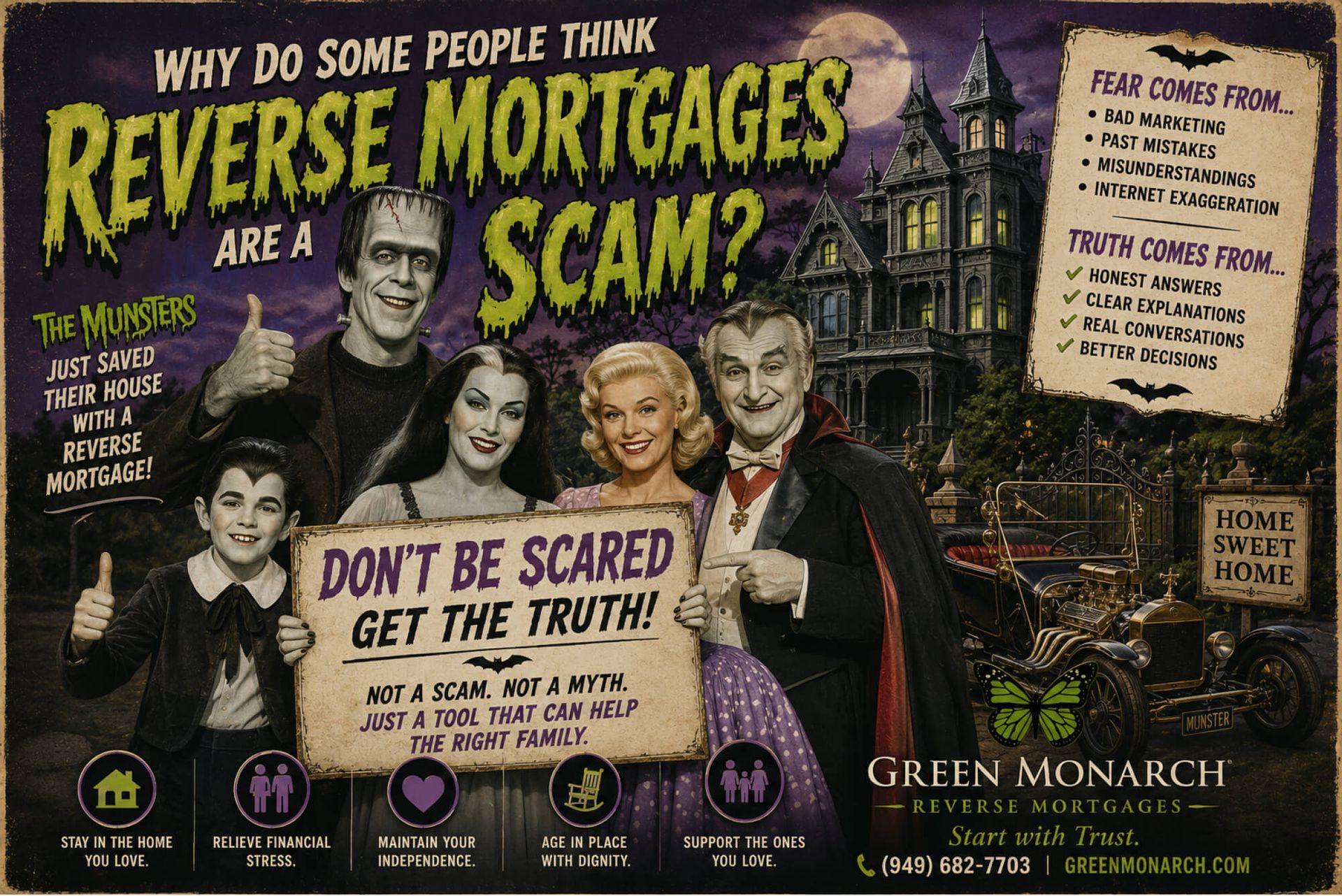
Why Do People Think Reverse Mortgages Are a Scam
The history behind why do people think reverse mortgages are a scam explains why many homeowners remain skeptical today.
If you are suspicious of reverse mortgages, that suspicion did not come from nowhere.
The reverse mortgage industry has a documented history of misleading advertising and enforcement actions involving companies that made claims federal regulators determined were deceptive.
That's important to acknowledge.
It is also important to understand what happened afterward.
Rules changed. Regulators took enforcement action. Borrower protections increased. And today's federally insured Home Equity Conversion Mortgage, commonly called a HECM, should not be confused with every misleading sales practice that has occurred around it.
The reputation has a real history. But that does not mean the loan itself is a scam.
Are Reverse Mortgages a Scam?
The answer to are reverse mortgages a scam requires separating the actual loan from the way some companies have marketed and sold it.
A HECM is a federally insured reverse mortgage program.
But legitimate financial products can still be marketed dishonestly.
That distinction helps explain much of the confusion surrounding reverse mortgages today.
Green Monarch's source material documents that federal regulators investigated reverse mortgage advertising, fined companies for deceptive practices, and imposed additional requirements following problems involving borrowers and the industry.
So dismissing every concern as a "myth" would ignore the history.
The better approach is to understand
what actually happened, what changed, and what homeowners should watch for today.
Why Reverse Mortgages Got a Bad Reputation
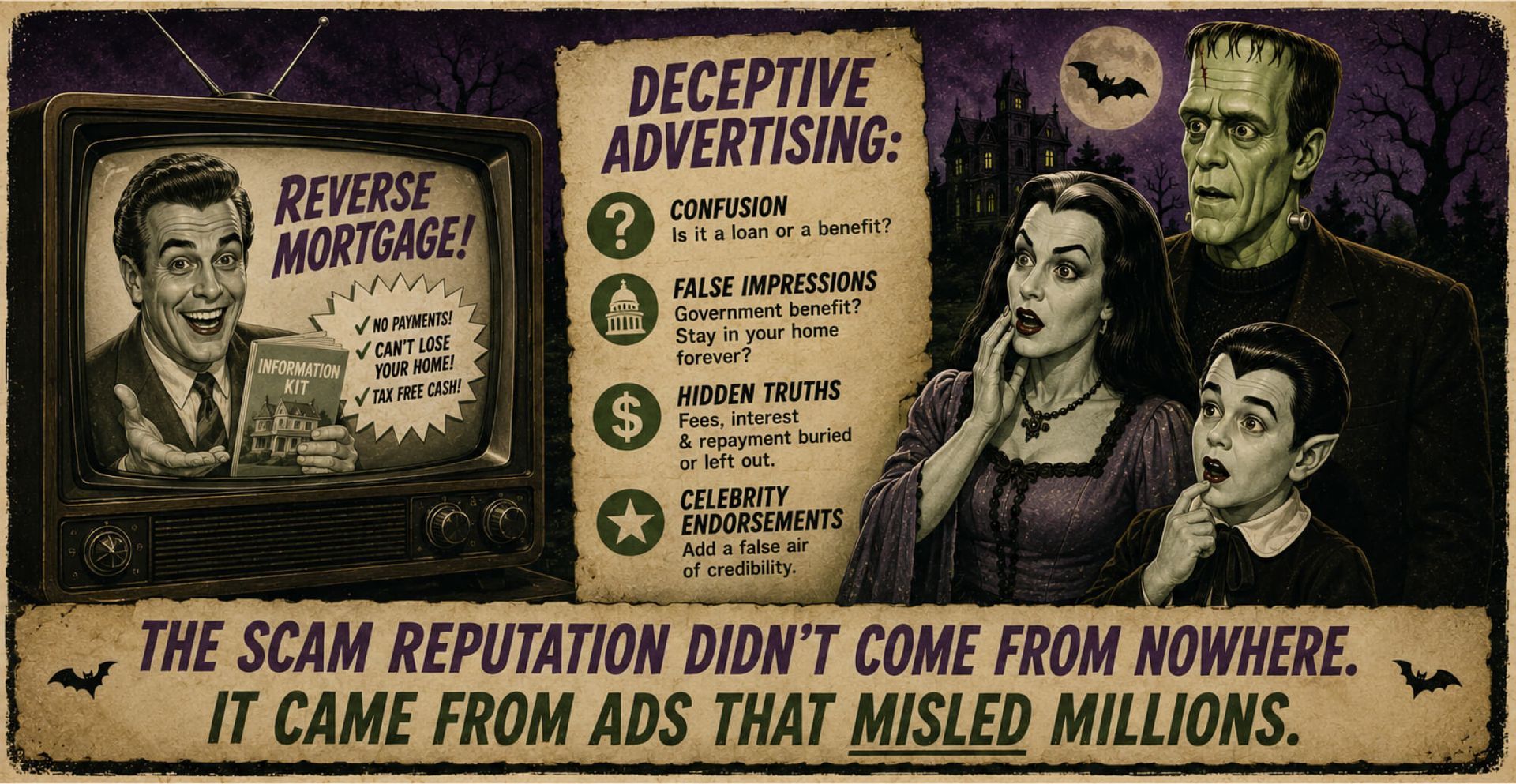
Part of why reverse mortgages got a bad reputation can be traced directly to advertising that left consumers confused about what they were being offered.
In 2015, the Consumer Financial Protection Bureau studied 97 reverse mortgage advertisements from television, radio, print and the internet. Those advertisements were shown to approximately 60 homeowners age 62 and older in Chicago, Los Angeles and Washington, D.C.
The results were troubling.
According to the source material, consumers were sometimes left with false impressions that reverse mortgages were government benefits rather than loans or that the products guaranteed they could remain in their homes for the rest of their lives.
Consumers also had difficulty recognizing from some advertisements that reverse mortgages were loans involving fees and compounding interest.
That's a serious problem.
And it helps explain the reputation.
Reverse Mortgage Lender Lies
Some of the reverse mortgage lender lies people remember were not simply rumors circulating on the internet. Federal regulators documented deceptive advertising claims and took enforcement action.
In 2016, the CFPB took action against three reverse mortgage companies over deceptive advertising.
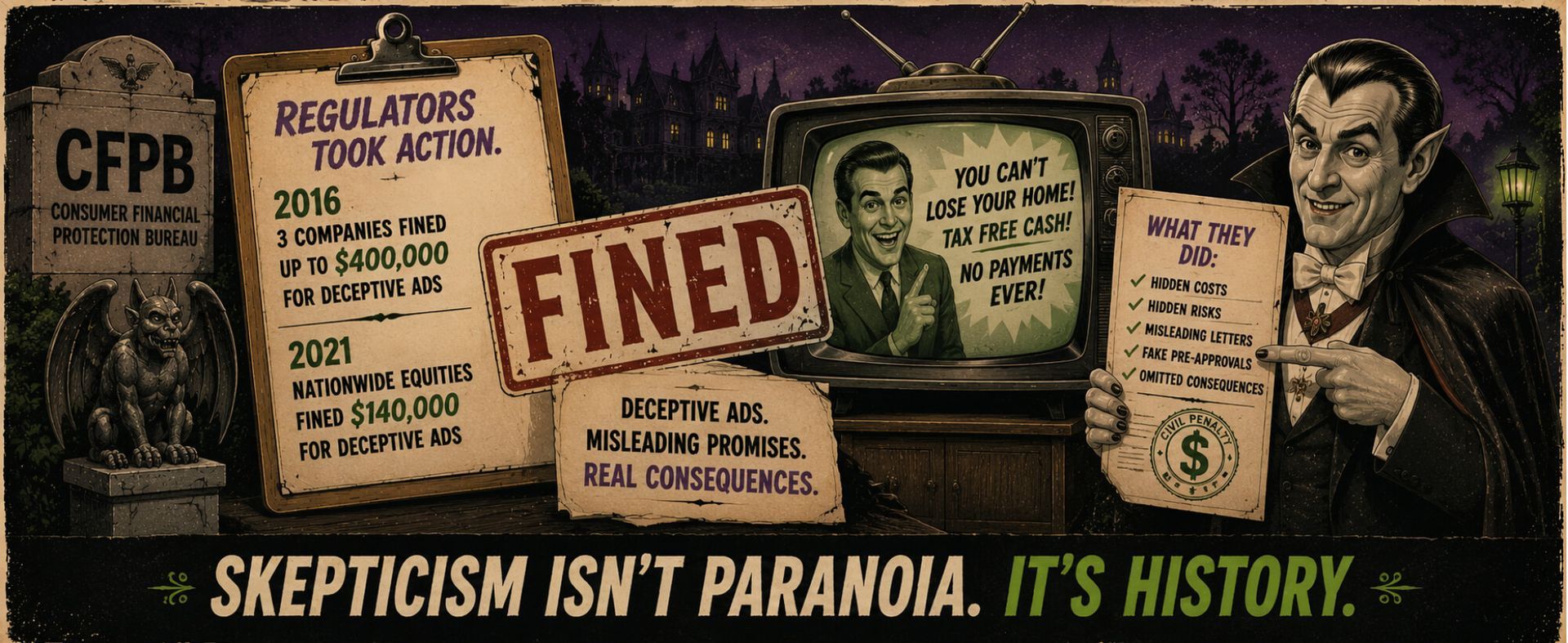
According to Green Monarch's source material, regulators objected to advertising that could leave consumers believing they could not lose their homes with a reverse mortgage.
Additional enforcement followed.
In 2021, the CFPB ordered Nationwide Equities Corporation to pay a $140,000 civil penalty related to deceptive reverse mortgage advertisements.
The source material identifies concerns involving how much money consumers could receive, fees and costs, consequences of failing to meet obligations, property taxes and insurance, claims implying relationships with consumers that did not exist, and representations about being "pre-approved."
That history matters because it provides context for today's skepticism.
When someone says,
"I don't trust reverse mortgages," there may be legitimate history behind that concern.
Can You Lose Your Home With a Reverse Mortgage?
One of the most important reverse mortgage truths homeowners should understand is that having a reverse mortgage does not eliminate your responsibilities as a homeowner.
Claims suggesting that a homeowner simply "can't lose the home" can be dangerously incomplete.
Reverse mortgage borrowers must continue meeting applicable loan requirements, including obligations involving property taxes and homeowners insurance.
The history helps explain why these requirements receive so much attention today.
Green Monarch's source notes that after approximately 10% of HECM borrowers, about 54,000 loans, failed to pay property taxes or homeowners insurance, Congress gave HUD authority to establish financial requirements. Beginning in 2015, lenders were required to conduct financial assessments of new HECM borrowers that include reviewing credit history and the borrower's history of paying property charges.
The lesson is not that reverse mortgages are scams.
The lesson is that
the responsibilities need to be explained clearly before someone gets one.
What Changed With Reverse Mortgages?
Several important reverse mortgage rules and protections changed as regulators responded to problems involving the program and its marketing.
Financial assessments were introduced for new HECM borrowers.
Advertising practices faced regulatory scrutiny and enforcement.
And companies involved in enforcement actions were required to address compliance issues.
Green Monarch's source specifically notes that the CFPB's order against Nationwide Equities required a compliance plan under which advertisements were reviewed for compliance with federal law before being used.
In other words, the problems were not simply ignored.
They produced consequences and changes.
That does not mean bad sales practices can never happen again.
It means today's homeowner should evaluate the current product and the person or company presenting it rather than relying entirely on either old horror stories or new marketing promises.
Are Reverse Mortgages Legitimate Today?
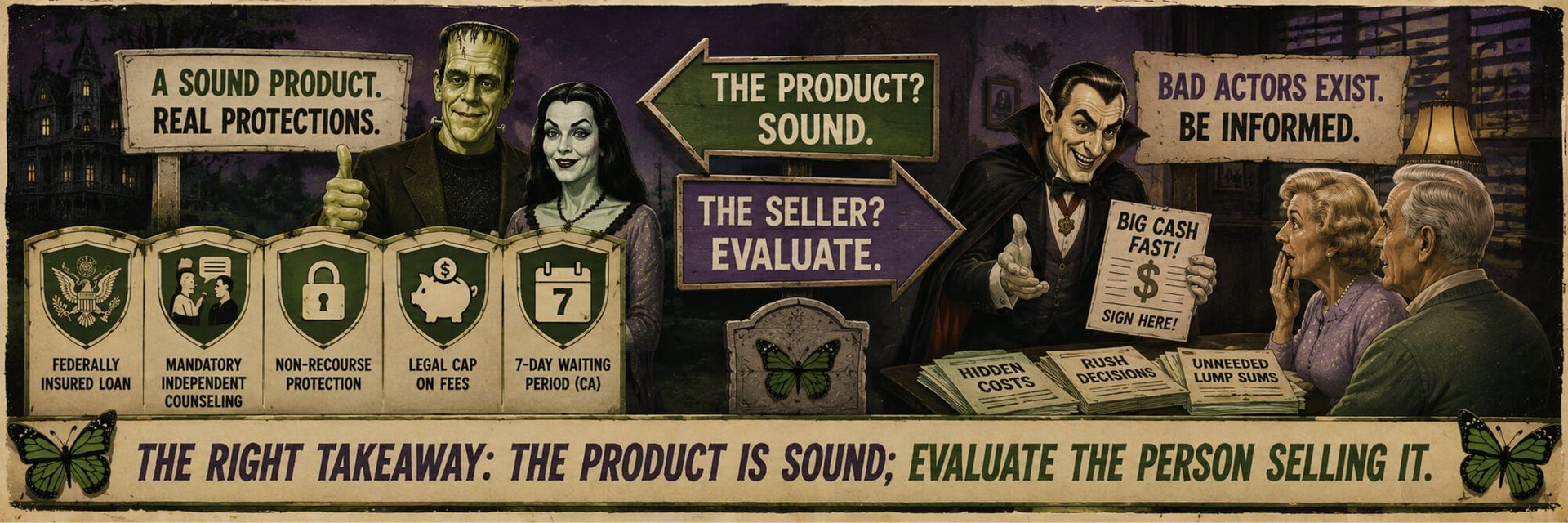
For homeowners wondering are reverse mortgages legitimate today, a HECM is a federally insured reverse mortgage loan with specific borrower protections and requirements.
Green Monarch's source material identifies protections including independent counseling, limits on certain lender fees and non-recourse protection. It also notes a California-specific waiting period before an application can be accepted.
But there is an important distinction:
A legitimate product does not guarantee that every person selling it will behave legitimately.
Green Monarch's source puts the issue clearly. A reverse mortgage itself may not be a scam, while a homeowner could still encounter someone using misleading or high-pressure tactics when selling one.
That's why choosing the lender matters.
Reverse Mortgage Scams in California
California homeowners concerned about reverse mortgage scams in California should pay close attention to both the loan terms and the behavior of the person presenting them.
Do not assume something is trustworthy simply because the salesperson sounds confident.
And don't assume something is a scam simply because you heard a bad story years ago.
Ask questions.
- Ask for costs to be explained.
- Understand the interest.
- Understand your continuing responsibilities.
- Know what happens to the loan over time.
- Include your spouse and, when appropriate, other family members in the conversation.
- Most importantly,
do not allow anyone to rush you into a financial decision involving your home.
Those are reasons to stop and ask more questions.
How to Spot Reverse Mortgage Red Flags
Knowing
how to spot reverse mortgage red flags may be more useful than simply asking whether the entire industry can be trusted.
Based on the documented concerns and warning signs discussed in Green Monarch's
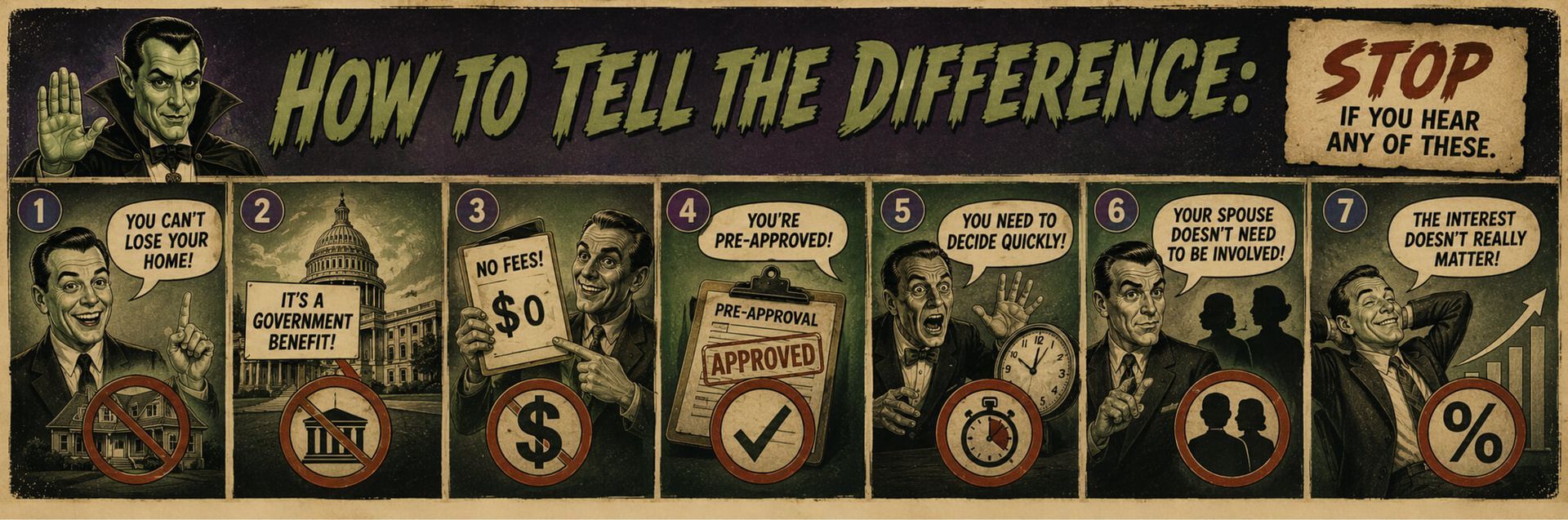
source material, be cautious if someone tells you:
- You can't lose your home.
- A reverse mortgage is a government benefit rather than a loan.
- There are no fees, or they refuse to clearly show you the costs.
- You're already "pre-approved" before the necessary evaluation has occurred.
- You need to make the decision quickly.
- Your spouse does not need to be involved in the conversation.
- Interest doesn't matter because you aren't making monthly mortgage payments.
Those are reasons to stop and ask more questions.
A reverse mortgage is a significant financial decision. You should understand what you are signing without pressure, confusion or embarrassment about asking questions.
How to Choose a Reverse Mortgage Lender in California
For homeowners considering how to choose a reverse mortgage lender in California, pay attention to how the lender behaves when the conversation becomes difficult.
Do they explain disadvantages as readily as advantages?
Will they discuss costs?
Will they explain what could cause the loan to become due?
Do they answer questions directly?
Are they willing to tell you when a reverse mortgage may not be the best option?
Do you feel educated, or do you feel sold?
That distinction can tell you a lot.
The product should be evaluated on its actual terms.
The lender should be evaluated on how honestly those terms are explained.
Green Monarch's Take on Reverse Mortgage Scams
Green Monarch's position on reverse mortgage scams and misleading sales practices is not to pretend the industry's history never happened.
The company states plainly that parts of the reverse mortgage industry behaved badly and that pretending otherwise would repeat the type of behavior that created the distrust in the first place.
That's why skepticism can actually be useful.
It makes you ask questions.
It makes you compare what you're being told.
It makes you examine the costs, responsibilities and risks instead of relying on an advertisement.
Green Monarch asks homeowners to judge today's reverse mortgage by what the product actually is and judge the lender by how that lender behaves.
If anyone, including Green Monarch, makes you feel
rushed, confused or embarrassed to ask a question, that tells you something important.
Get the Facts Before You Decide
If you're researching reverse mortgages in California, don't replace one extreme with another.
Don't assume every reverse mortgage is a scam.
But don't assume every salesperson deserves your trust either.
Learn how the loan works. Understand the costs. Know your responsibilities. Ask what happens if your circumstances change. Talk with your family when appropriate.
Then make the decision based on facts rather than fear or sales pressure.
Green Monarch's educational approach is designed to help California homeowners understand the costs, rates, advantages and honest downsides before deciding whether a reverse mortgage fits their situation.
Call
Green Monarch at (800) 345-2041 when you're ready to ask questions and discuss your options.